
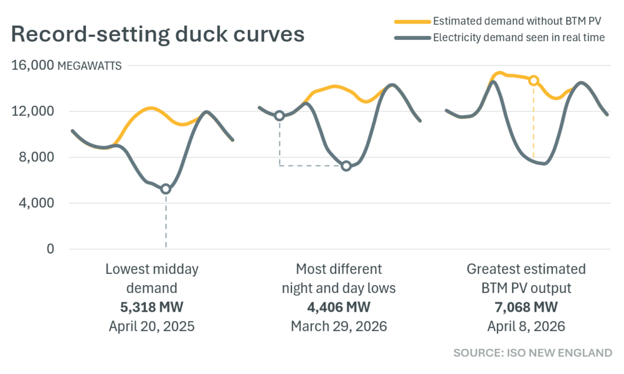
On September 21, 2026, ISO New England recorded the region’s 500th “duck curve” day. A duck curve occurs when electricity demand on the regional grid falls lower at midday than overnight, because rooftop panels and other distributed solar systems cover a large share of local needs while the sun is high. Plotted over 24 hours, demand sags through the afternoon and climbs steeply into the evening, tracing the outline of a duck.
The milestone arrived quickly. New England’s first duck curve occurred in April 2018, and it took nearly five years to accumulate the first 100. The most recent 100 took just 221 days.
For businesses, institutions, and communities, this trend carries real consequences. The timing of electricity now matters as much as the amount generated, and that shift is fueling rapid growth in battery energy storage.
What the Duck Curve Tells Us
ISO New England estimates that distributed solar generated 9,926 gigawatt-hours (GWh) in 2025, roughly 8 percent of the electricity New Englanders drew from the grid that year. On Easter Sunday 2025, grid demand fell to a record low of 5,318 megawatts (MW) in the early afternoon.
The pressure point comes at sunset. As solar output fades, demand rebounds quickly, and grid operators must call on other resources to keep supply and demand balanced. Much of that evening ramp has traditionally been met by fast-starting fossil fuel plants, often among the most expensive resources on the system.
Battery storage is built for this pattern. Batteries can charge when midday solar is plentiful and discharge as demand rises into the evening, turning a timing mismatch into dependable, dispatchable energy.
Storage Is Scaling Fast Nationwide
- Record installations: The U.S. installed a record 20.2 GWh of new storage capacity in the second quarter of 2026, according to the Solar Energy Industries Association
- Growing contribution: Battery storage supplied more electricity to the U.S. grid in the first eight months of 2026 than in all of 2025.
- Longer-lasting systems: The average duration of new battery systems rose from 2.8 to 3.5 hours, according to the American Clean Power Association.
Connecticut’s Storage Goals
Connecticut has set a goal of deploying 1,000 MW of energy storage by the end of 2030, and it is pursuing that target on two fronts. For large, grid-connected projects, the Department of Energy and Environmental Protection (DEEP) opened a proceeding earlier this year on how to procure and value front-of-the-meter storage, laying the groundwork for a future request for proposals. For homes and businesses, the Energy Storage Solutions program, run with the Connecticut Green Bank, offers incentives for qualifying batteries.
What This Means for Commercial and Industrial Energy Users
For businesses, municipalities, and other large energy users, storage can help:
- Reduce peak demand charges by discharging stored energy when facility usage spikes
- Capture more value from on-site solar by shifting midday generation into later, higher-value hours
- Strengthen resilience for critical operations, when systems are designed to provide backup power
- Position facilities to benefit as battery storage programs continue to develop
Talk to Verogy About Storage
Verogy develops clean energy projects for businesses, institutions, and communities, and our team can help you assess whether battery storage makes sense for your facility. Whether you already have solar on site or are planning a new project, we can evaluate how storage could lower your energy costs and support your long-term goals.